
Measured, not guessed
Every position is measured and marked so that it suits your ear and sits properly. You see it and confirm it before I continue.
Medical Piercer · Trainer
Expert in medical piercings
Medical Piercer for ten years. 46 years old, at home in Upper Bavaria, married, two young children — and on the road for most of the year.
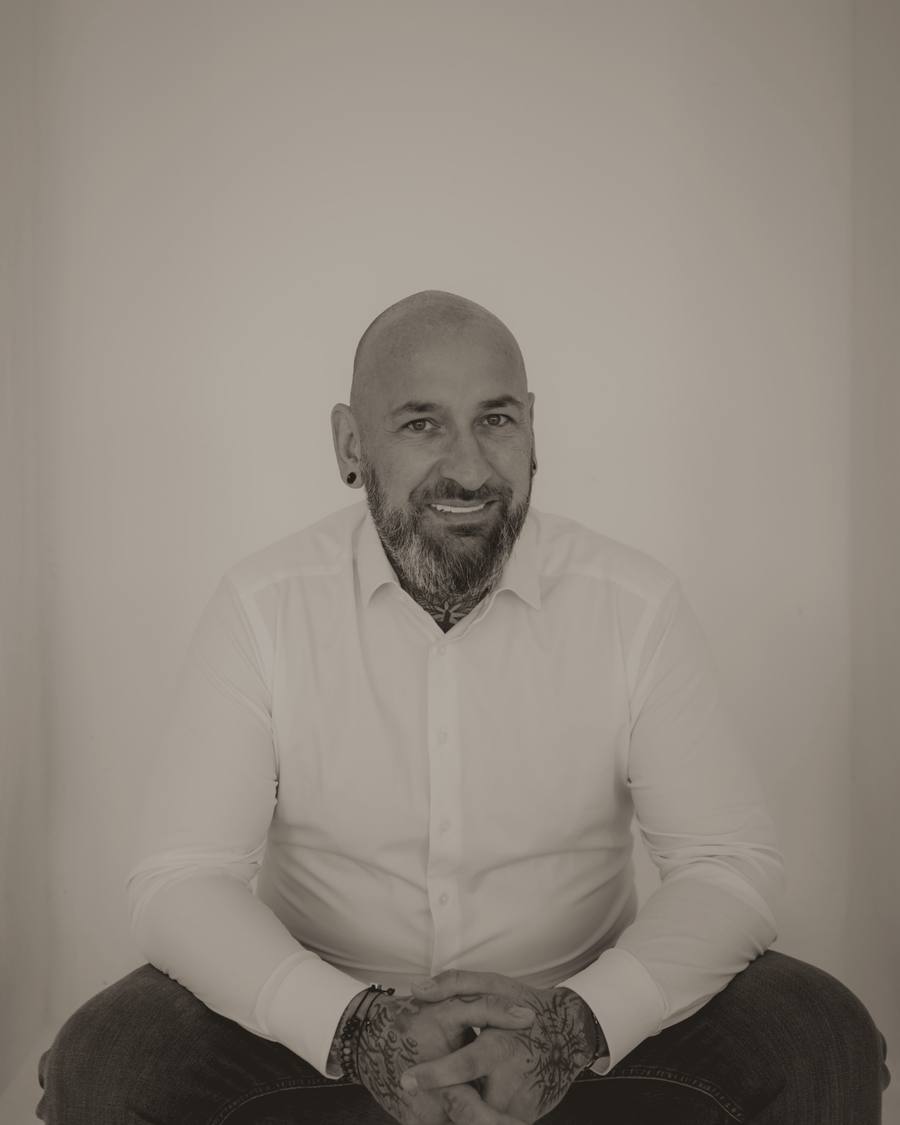
A medical piercing is a piercing at a spot on the ear that is known from auricular acupuncture. Unlike an acupuncture needle, which comes out again after the session, the jewellery stays in permanently.
The best-known example is the daith, the innermost fold of cartilage above the ear canal. The spots are known from the point charts of auricular acupuncture.
In terms of craft, it is a piercing like any other, with the same requirements: a sterile single-use needle, initial jewellery made of Bioplast or titanium to ASTM F136, and proper aftercare. The difference lies in the choice of spot. You will find all positions in the piercing guide.
Whether the stimulation has any effect is still an open question. That is exactly what the study I worked on investigated. What is known about it can be found on the Effectiveness page. A medical piercing does not replace a medical diagnosis or treatment.
FoxMed began in 2016 out of an interest that went beyond looks: ear jewellery has existed for centuries, and from the very beginning I was interested in more than just how it looks.
What started privately became a fixed way of working over the years. Today there are ten years behind it, six countries and one principle that has never changed: I measure, I don't guess.
Part of this development was finding my own path. At some point, working with others no longer matched the way I wanted to work myself. Since then I have worked alone and to my own standards — even where nobody asks them of me.
Some people still know me by my former name, Steffen Hufenbach, or from my time as vonHufi. Since changing my name I have worked as Steffen Fuchs — and increasingly appear in public as Steffen Fox.
At the Central Institute of Mental Health in Mannheim, a scientific study looked at whether ear piercings have an influence on migraine attacks. I was asked to carry out the practical part — as the only piercer, and in direct cooperation with the institute. The piercing itself was not part of the study. What was examined was how the participants' migraine developed after the piercing.
This makes me the first piercer in Germany to have taken part in a scientific study by a research institute.
What was needed was exactly what I stand for as an expert and piercer for medical piercings: knowledge of the tissue, the materials and a technique that can be repeated. Without that, a study cannot be evaluated — if everyone pierces differently, in the end you are measuring the piercer and not the piercing.
My role was that of intervention lead. I did the piercing. The evaluation was done at the institute.
This is how the study worked: participants aged 18 to 65 with migraine received a daith piercing in both ears. Before and for four months afterwards they kept a daily headache diary in an app and regularly filled in questionnaires. The frequency, duration and intensity of the attacks were examined, as well as quality of life and mood.
Data collection is complete; the publication is still pending. I don't know what it will say — and I won't claim anything here before it can be read.
This includes what the institute states on its website: until then there was no evidence of effectiveness, and the German Migraine and Headache Society advises against piercings for migraine. That is exactly why we investigated it.
I am putting this so clearly because a lot of the opposite is claimed online. I don't promise any effect. I made sure that the question could be asked properly.
Universities of applied sciences, evening classes, seminars — I acquired the knowledge myself.
On top of that, the official piercing exam in Italy, passed in Bolzano. In the Autonomous Province of Bolzano it is mandatory; in Germany nobody requires it. I took it anyway.
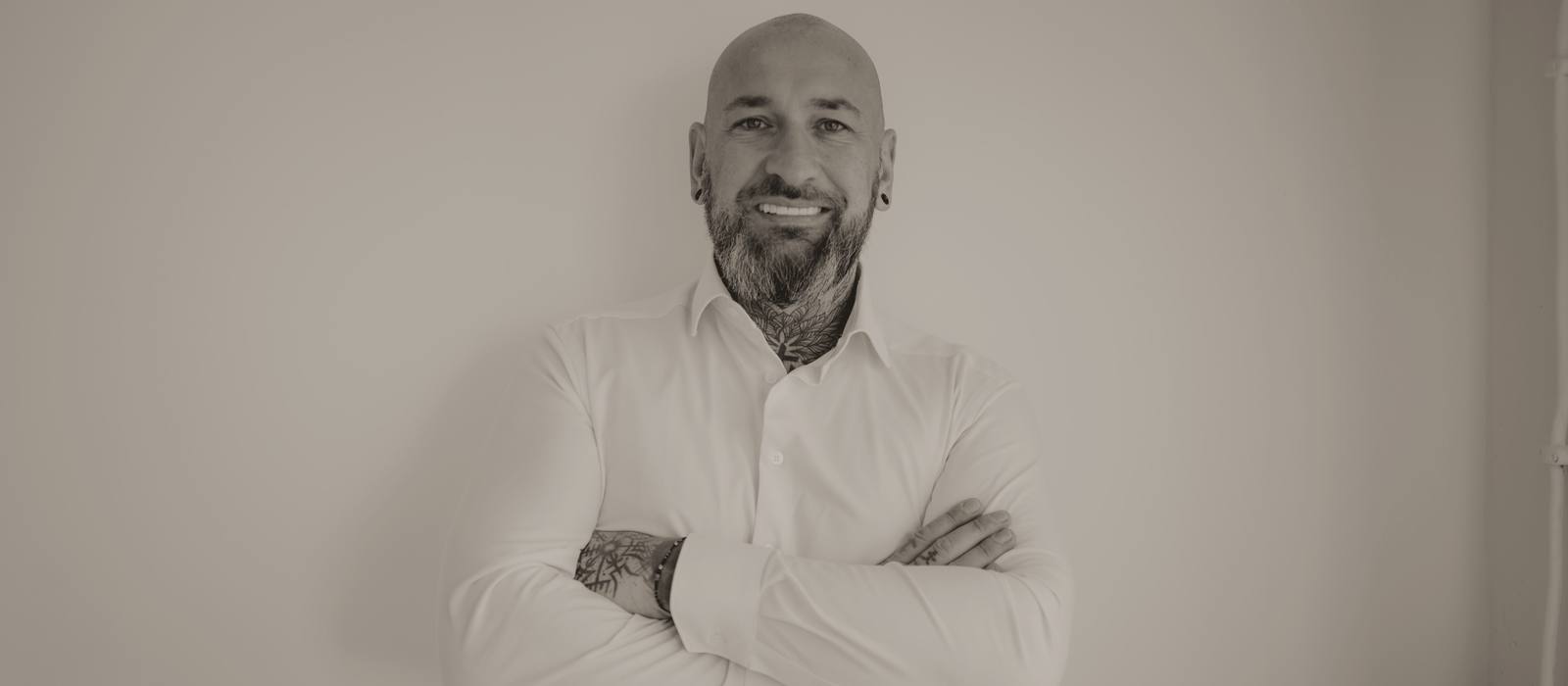
There is no second piercer at FoxMed. The one ringing your doorbell is me — from the first conversation to the aftercare. That is exactly why you can rely on every appointment going the same way: the same preparation, the same standards, the same person.
The only other person involved is my wife Nicki. She supports women under her own name, as her own offering — more about the two of us.
I work with established studios in six cities and regularly exchange ideas with colleagues. I always carry out the procedure myself.
Every position is measured and marked so that it suits your ear and sits properly. You see it and confirm it before I continue.
Every needle, every glove and every stud comes sterile-packed and is used only once.
Before I touch anything: the procedure, possible side effects, care, aftercare. Questions at any time.
I don't do intimate piercings. And if I don't have a good feeling, I say so openly — even if that costs me an appointment. Not every sale is a good sale. That is one of the reasons I have been able to do this for ten years.
Hardly anyone travels 500 kilometres for an appointment. So I do the travelling.
You stay where you feel comfortable — at home, with people you know. I have been making home visits all over Europe since 2016.
My longest trip so far: around 1,200 kilometres to Nantes.
A piercing is only truly successful once it has healed well. That's why my work doesn't end with the piercing. You get detailed aftercare instructions from me and a personal briefing, so you know exactly what matters over the next few weeks.
This includes proper cleaning: gently, regularly and with suitable products, without irritating the area. I explain why you shouldn't twist the piercing or touch it unnecessarily, and how to remove crusts gently.
There are also a few things to bear in mind in everyday life. At first you should avoid swimming pools, saunas and sunbeds, and take care not to sleep on the fresh piercing. Headphones, hats, hairspray or make-up can put strain on the area, so I'll show you how best to deal with them.
Cartilage piercings in particular, such as those often placed at acupuncture points on the ear, need patience. Complete healing can take several months, even if the piercing seems settled earlier.
After the appointment I remain available to you. If something looks unusual, there is swelling or you are unsure, just get in touch. If needed, I'm happy to take another look at the piercing and adjust the jewellery, for example if a shorter bar makes sense once the swelling has gone down.
That way you can rely on safe healing and enjoy your jewellery for a long time.
The permanent stimulation of selected acupuncture points can be aimed at accompanying certain complaints and symptoms in a positive way. At the same time, it is worth looking at possible causes and at the body as a whole.
If you wish, my wife can therefore be involved as well. She advises on a conscious lifestyle, high-quality food supplements and supportive care, tailored to the individual situation.
Topics such as gut and digestion, joints and mobility, menstrual complaints, skin and complexion, stress and mental strain, sleep and recovery, the immune system, energy and performance, weight management, metabolism and general nutrient supply can be taken into account.
This creates a holistic approach in which not only the symptom is at the centre, but also the question of how the body can additionally be supported from the inside and outside.
Note: medical piercing, food supplements and advice do not replace a medical or therapeutic diagnosis or treatment.
So far I have worked in six countries: Germany, Austria, Italy, France, Switzerland and Spain. I have established studios in four of them.
At the beginning of 2027 I am leaving Germany. Not to stop — but to build something that can't be done with a suitcase.
The Medical Center FoxMed is being created in Cyprus.
What is planned is a form of cooperation that doesn't exist yet in this way: doctors, naturopaths and an aesthetic team under one roof, each in their own field, with short distances in between.
The opening is planned for October 2027; the premises are being planned.
Nothing changes about the home visits. I will keep coming to you in Germany, Austria, Italy and France — before and after. The only difference is where I am in between.
On top of that comes a place where you can find me, instead of waiting for the next appointment near you. Those who have already been to me will hear about it first.
Planning status, September 2026. Dates may change.
I hold seminars and train people — in medical and aesthetic piercings. Few participants, with a practical part and support.
After ten years, I meet people again who remember every detail of the appointment. That's the part that gets me on the road in the morning.
In these ten years, not a single client came through an advert. Everyone came because someone else told them.
The quickest way is via Instagram. Tell me where you live and how many of you there are, and I'll get back to you with suggested dates.